

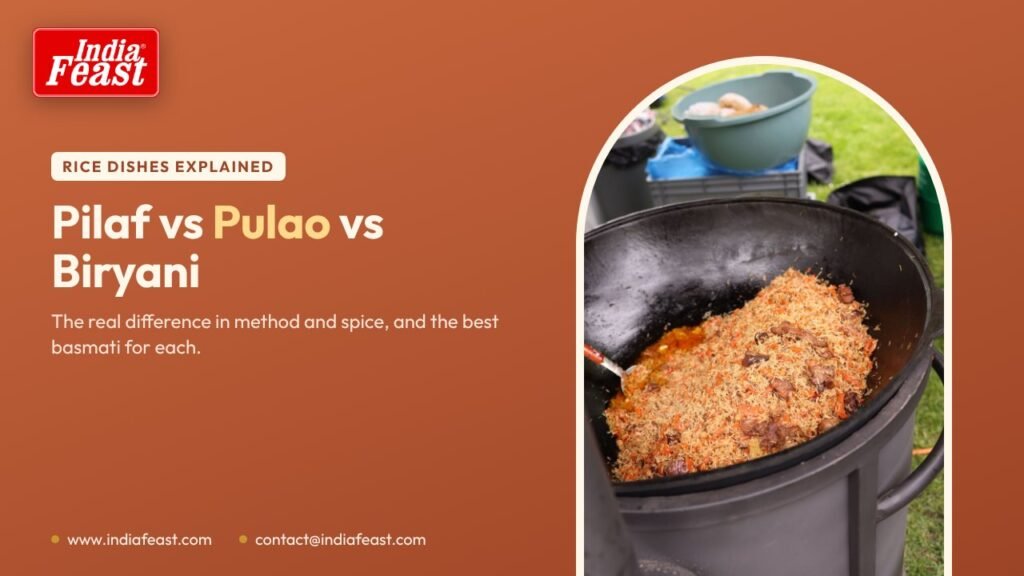
Pilaf vs Pulao vs Biryani: The Real Difference and the Best Basmati for Each
By Indiafeast Team · Updated 13 November 2026
Pilaf, pulao and biryani are often used as if they were three words for the same dish. They are related, but they are not the same, and the pulao vs biryani question in particular confuses many cooks. Mixing up pulao vs biryani matters in the kitchen, because the three dishes use different methods, and the method decides how much water, spice and time the rice needs.
This guide settles pilaf vs pulao vs biryani properly: where each comes from, how the cooking methods differ, what each dish asks of the rice, and which basmati grade gives the best result. The Indiafeast Team mills the grades named below and cook-tests them regularly, so the advice comes from the pot, not just the page.
One family, three branches
All three dishes descend from the old technique of cooking rice in seasoned stock rather than plain water. The idea travelled with Persian cooking across Central Asia, the Middle East and South Asia, changing its name and character along the way: pilaf and plov in the west and north, pulao in South Asia, and in the Mughal kitchens of the subcontinent the layered, celebratory biryani (Wikipedia, Biryani).
A useful way to remember pilaf vs pulao vs biryani: every biryani is built on skills learned from pulao, and every pulao is a member of the pilaf family, but the three are cooked differently.
Pilaf vs pulao vs biryani at a glance
| Pilaf | Pulao | Biryani | |
|---|---|---|---|
| Home | Middle East, Central Asia, Turkey, beyond | India, Pakistan, Bangladesh, Afghanistan | South Asia (Mughal kitchens) |
| Method | One pot, absorption | One pot, absorption | Rice and masala cooked separately, then layered and steamed (dum) |
| Spice level | Gentle, often just stock and aromatics | Mild, whole spices | Bold: marinades, fried onions, saffron, garam masala |
| Rice look | Even colour throughout | Even colour throughout | Mixed: white, saffron and masala-stained grains |
| Effort | Easy | Easy | A project: marinate, parboil, layer, dum |
| Texture goal | Tender, separate | Tender, separate | Long, dry, very separate grains |
How the methods differ: pilaf vs pulao vs biryani
Pilaf: toast, then absorb
A classic pilaf starts by toasting the rice in butter or oil with onions until the grains turn lightly golden. Hot stock goes in, the pot is covered, and the rice absorbs the liquid over low heat. The toasting coats each grain in fat, which keeps them separate and adds a nutty note. Turkish pilav, Uzbek plov and Gulf rice dishes such as kabsa and machboos are all cousins in this family.
Pulao: the one-pot aromatic
Pulao follows the same absorption idea with South Asian aromatics: whole spices such as cumin, cardamom, cloves and bay bloomed in ghee, then vegetables, chicken or mutton, then soaked rice and measured water or light stock. Everything finishes together in one pot. A good pulao tastes gentle and clean, and the meat or vegetables flavour the rice from within.
Biryani vs pulao: the parboil, layer and dum method
Biryani separates the two halves of the dish. The meat is marinated, often in yogurt and spices, and cooked into a rich masala. The rice is boiled separately in heavily salted, spiced water to about 70 to 80% done, then drained and layered over the masala with fried onions, herbs and saffron milk. The sealed pot then sits on very low heat so the steam (dum) finishes the rice and marries the layers. The reward for the extra work is contrast in every spoonful: dry, fragrant grains against rich masala.
Which basmati grade for each dish
The dishes make different demands on the grain, so the right grade changes with the method. For a full comparison of the two most common varieties, see our 1121 vs 1509 basmati guide, and for what each processing form does to the grain, the raw, steam and sella explainer.
| Dish | First choice | Why | Water (per cup soaked rice) |
|---|---|---|---|
| Pilaf | 1121 or 1509 Steam | Firm enough for toasting, cooks evenly by absorption | About 1½ cups |
| Pulao | 1121 Steam or Raw | Raw gives the most aroma; steam is more forgiving | 1⅓ to 1½ cups |
| Biryani (home) | 1121 Steam or Raw | Extra-long grains that stay separate after the dum | Boil-and-drain, then dum |
| Biryani (restaurant/bulk) | 1121 Sella | Parboiled grain survives holding and reheating | Boil-and-drain, then dum |
Two practical notes from the mill. First, aged rice matters more for biryani than for any other dish, because aged grains cook drier and longer; ask your supplier for properly aged stock. Second, restaurants that hold biryani hot for hours should use sella, as raw basmati softens on the line. Our guide to the basmati ultimate guide covers ageing in detail.
A simple chicken pulao to learn the pilaf vs pulao vs biryani family
Ingredients (serves 4)
- 2 cups (about 370 g) 1121 steam basmati, washed and soaked 30 minutes
- 500 g chicken pieces on the bone
- 3 tbsp ghee or oil
- 1 large onion, thinly sliced
- 1 tbsp ginger-garlic paste
- Whole spices: 1 tsp cumin seeds, 4 cardamom pods, 4 cloves, 1 cinnamon stick, 2 bay leaves
- 1 green chilli, slit; 2 tbsp yogurt
- 3 cups hot water or light stock; salt to taste
- Fresh coriander and mint to finish
How to make it
- Bloom the spices. Heat the ghee and fry the whole spices for 30 seconds until fragrant.
- Brown the onion. Add the onion and fry until golden brown; this builds most of the pulao's flavour.
- Cook the chicken. Add ginger-garlic paste, then the chicken and chilli. Sear until the chicken loses its pinkness, then stir in the yogurt.
- Add rice and water. Add the drained rice, pour in the hot water, season with salt until the liquid tastes slightly salty, and stir once.
- Absorb and steam. Boil uncovered until the water sinks below the rice, then cover tightly and cook on the lowest heat for 15 minutes.
- Rest and serve. Rest 10 minutes off the heat, fluff gently, and finish with coriander and mint.
Pulao vs biryani in practice: to move from pulao to biryani, double the marinade and cook the chicken into a thick masala, boil the rice separately to 75% in salted water, layer rice over masala with fried onions and saffron milk, and steam the sealed pot on the lowest heat for 20 to 25 minutes.
Regional members of the family worth knowing
Once you can tell the three branches apart, the regional versions make much more sense. A few worth knowing, and what they teach about the method:
- Uzbek plov: pilaf cooked in a kazan with lamb, carrots and whole garlic. Shows how far the toast-and-absorb method travels; our Kabuli pulao recipe is a close Afghan cousin.
- Turkish pilav: often cooked with orzo toasted in butter. Proof that the toasting stage, not the spice, defines pilaf.
- Yakhni pulao: a South Asian pulao where the rice cooks in a bone stock (yakhni). The gentlest of the family, with deep flavour and almost no chilli.
- Hyderabadi kacchi biryani: raw marinated meat cooked entirely under the rice during dum. The most demanding version, and the reason aged, extra-long basmati commands a premium.
- Kolkata biryani: famous for its potato and egg and a lighter spice hand. A reminder that biryani is defined by layering and dum, not by heat.
East African pilau, which we cover in our Kenyan pilau recipe, sits between the branches: one pot like a pulao, with its own dark-fried onion and pilau masala character.
Pulao vs biryani: 6 quick differences
If you only remember one part of this guide, make it this list. These are the points cooks and restaurant buyers ask about most when they compare pulao vs biryani.
| Pulao | Biryani | |
|---|---|---|
| Cooking method | One pot, rice absorbs the stock | Rice boiled separately, layered and steamed (dum) |
| Spice level | Mild, whole spices | Rich masala, marinade, saffron and fried onions |
| Look on the plate | Even colour | Mixed white, saffron and masala grains |
| Time | About 45 to 60 minutes | About 2 to 3 hours, including marinating |
| Water | Measured, about 1:1.5 for soaked 1121 steam | Plenty of salted water, then drained |
| Best basmati | 1121 steam or raw | Aged 1121 steam or raw; 1121 sella for bulk |
In short, the pulao vs biryani difference is about method first and spice second. A one-pot rice is a pulao however rich it tastes, and a layered, dum-steamed rice is a biryani however mild it is.
Common mix-ups about pulao vs biryani, settled
- "Biryani is just spicy pulao." No. The real pulao vs biryani difference is method, not heat: pulao cooks everything together by absorption, biryani layers separately cooked rice and masala.
- "Pilaf and pulao are different dishes." In the pilaf vs pulao debate, they are the same family and method under different names; pulao is the South Asian branch with its own spice voice.
- "Any long rice works for biryani." Short or soft grains clump during dum. Extra-long aged basmati is the standard for a reason.
- "More water makes softer, better rice." For all three dishes, excess water is the main cause of mush. Measure against the grade you use.
- "Saffron goes in the pot." In biryani, saffron milk is drizzled over the top layer so the finished dish has contrasting white and gold grains.
Buying rice for pulao and biryani in bulk
Restaurants and retailers usually stock two grades to cover both sides of a pulao vs biryani menu: a steam or raw 1121 for pulao, pilaf and premium biryani, and a sella grade for high-volume biryani and buffet service. If you are building a range, start there, and cook-test samples of each against your own menu before committing to a container.
Buying rice for this recipe?
- Explore our full basmati rice range in raw, steam, white sella and golden sella forms.
- See the retail and catering packs in the Indiafeast basmati rice brand.
- Check this week's basmati rice price for bulk orders.
- Learn how we clean, sort and grade every lot on our rice manufacturing page.
- Visit the Indiafeast Millers home page or send a bulk enquiry.
Stocking basmati for pulao vs biryani menus?
Indiafeast Millers exports aged 1121 and 1509 basmati in raw, steam and sella forms, with private label packs for importers and distributors. Tell us your dishes and we will recommend grades to sample.
Ask for grade samplesFAQ: pulao vs biryani
What is the difference between pulao and biryani?
Pulao cooks rice and meat or vegetables together in one pot by absorption. Biryani cooks them separately, then layers parboiled rice over the masala and finishes the sealed pot on low steam. Biryani is bolder and keeps distinct layers.
Are pilaf and pulao the same thing?
Essentially yes. Pilaf is the broad international family of rice cooked in seasoned stock, and pulao is the South Asian branch of that family, usually flavoured with whole spices in ghee.
Which rice is best for biryani?
Extra-long aged basmati. At home, 1121 steam or raw gives the longest, most fragrant grains. Restaurants holding biryani hot for hours usually choose 1121 sella because the parboiled grain stays firm.
Which rice is best for pulao and pilaf?
1121 steam basmati is the easiest all-rounder, with 1121 raw for maximum aroma and 1509 steam as a value option. Use about 1⅓ to 1½ cups of water per cup of soaked rice.
What does dum mean in biryani?
Dum is the final slow-steaming stage: the layered pot is sealed, traditionally with dough, and left on very low heat so the rice finishes in trapped steam and absorbs the masala's aroma.
Is biryani always spicier than pulao?
Usually, but the real difference is structure. A mild biryani is still biryani because it is layered and steamed, and a fiery pulao is still pulao because everything cooks together.
Pulao vs biryani: which is healthier?
Pulao is usually lighter because it uses less oil or ghee, no fried onions and a milder masala, while biryani is richer. The rice itself is the same basmati, so the difference comes from fat and portion size rather than the grain.
Biryani vs pulao: which is easier for beginners?
Pulao is easier. It cooks in one pot with measured water, so it teaches the basics of soaking, blooming spices and steaming. Once you are confident with pulao, the parboil-and-layer method of biryani is the natural next step.
What is the pulao vs biryani difference in one line?
Pulao cooks rice and meat together in one pot, while biryani layers separately cooked rice over a rich masala and steams them together; that is the whole pulao vs biryani difference.
Written by Indiafeast Team, Indiafeast Millers. Methods and sources checked on 13 November 2026. Regional versions differ widely, so treat these as the classic forms of each dish.