

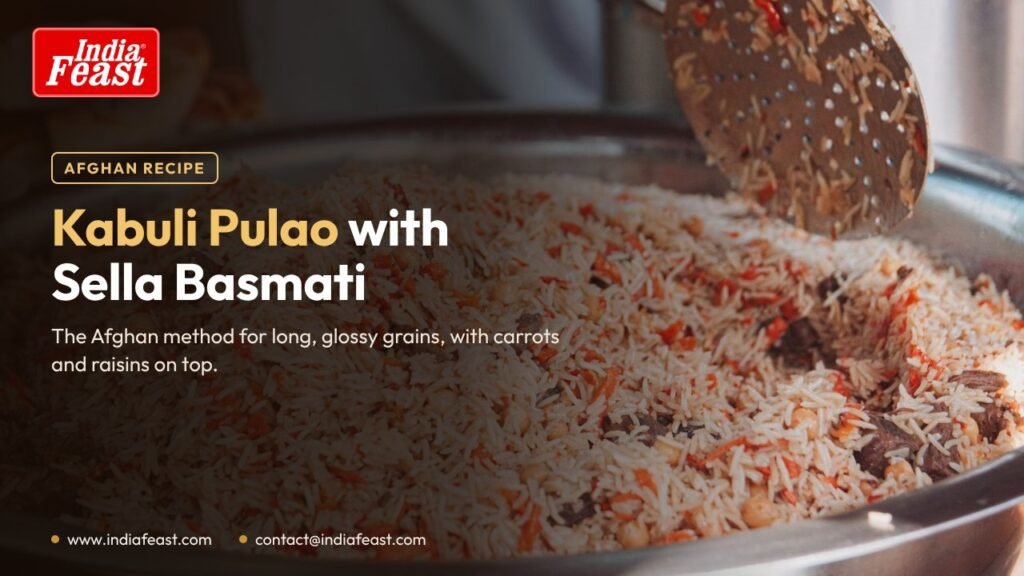
Kabuli Pulao with Sella Basmati: The Afghan Method for Long, Glossy Grains
By Indiafeast Team · Updated 12 November 2026
Walk into a good Afghan restaurant in Dubai, London or Kabul and the platter of kabuli pulao tells you a lot about the kitchen. The rice should be long, glossy and brown from the stock. Every grain should sit apart from its neighbour. That finish depends on the rice as much as the cook, and it is why so many chefs pair kabuli pulao with sella basmati.
Indiafeast Millers supplies 1121 Golden Sella to Afghan and Gulf buyers, and they ask us the same question every season: which rice holds up best through a long stock cook and an hour in the oven? This recipe answers it from the rice side, then gives you a full, kitchen-ready method with lamb, browned stock, cumin, cardamom, carrots and raisins.
Why kabuli pulao and sella basmati work so well together
Kabuli pulao, also written qabili palaw, is a festive dish of steamed rice, meat, caramelised carrots and raisins. Despite the name, it probably began on the border of northern Afghanistan and Uzbekistan. In Saudi Arabia the same family of dish is sold as Bukhari rice, and the earliest written qabili recipes go back to a Safavid-era cookbook from 1521 (Wikipedia, Kabuli pulao).
The traditional Afghan method steams the rice, so good Afghan pulao rice has to survive two hard tests. First it boils in rich, oily stock. Then it sits under a sealed lid in a hot oven. Weak rice swells, splits and clumps. Sella rice is parboiled in the husk before milling: the paddy is soaked, steamed and dried, which gelatinises the starch and locks the grain together. You can read the full process in our guide to parboiled rice.
In the pot, that hardened structure does three useful jobs. It soaks up more stock without bursting. It keeps a firm bite after the dam. And it gives the glossy surface that makes a pulao platter look generous. Golden sella also carries a light amber tone from the parboiling, which blends with the browned stock and gives an even colour.
| What the cook sees | 1121 Golden Sella | 1121 Steam | 1121 Raw |
|---|---|---|---|
| Behaviour in a long stock cook | Very firm, holds shape | Good, softens sooner | Softest, most delicate |
| Water needed after soaking | Most (about 1:1.75) | Less | Least |
| Risk of breaking in the oven dam | Low | Medium | Higher |
| Colour before cooking | Light golden | Creamy white | White |
| Best use | Pulao, mandi, kabsa, buffets | Biryani, retail packs | Home-style plain rice |
Our 1121 specs: average raw grain length 8.30 to 8.40 mm, moisture max 12.5%, broken max 1%, purity min 95%. The comparison above is general kitchen behaviour. Rice age and your pot will shift the exact water you need.
For a side-by-side look at each form, see our explainer on raw, steam, white, creamy and golden sella basmati. Cooking a Gulf rice dish instead? Our guide to the best rice for kabsa uses the same grade.
Ingredients for kabuli pulao (serves 6)
- 600 g (3 cups) 1121 Golden Sella basmati rice
- 1.2 kg bone-in lamb shoulder or neck, cut into 6 large pieces
- 120 ml (½ cup) sunflower or other neutral oil, plus 2 tbsp for the carrots
- 2 tbsp white sugar, for colouring the stock
- 2 large onions (about 350 g), thinly sliced
- 4 garlic cloves, crushed
- 2 tsp ground cumin
- 1 tsp ground green cardamom
- 1 tsp ground black pepper
- 1 tbsp salt, or to taste
- 1.8 litres (7½ cups) water, for the lamb
- 3 large carrots (about 400 g), cut into thin matchsticks
- 150 g (1 cup) dark or golden raisins
- 1 tbsp sugar, for the carrots
- 50 g (⅓ cup) slivered almonds or pistachios, optional
Kabuli pulao recipe: step by step
- Soak the rice (60 minutes). Rinse the rice 3 to 4 times until the water runs almost clear. Cover with cool water and soak for 60 minutes while the lamb cooks.
- Colour the oil (3 minutes). Heat 120 ml oil in a heavy, ovenproof pot over medium heat. Add 2 tbsp sugar and stir until it melts and turns dark amber. Watch it closely, as it burns fast.
- Sear the lamb (10 minutes). Add the lamb straight into the caramel oil, stand back from the spatter, and turn the pieces until browned on all sides.
- Brown the onions (10 minutes). Add the onions and cook, stirring, until deep brown. Stir in the garlic, cumin, cardamom, pepper and salt for 1 minute.
- Make the stock (75 minutes). Pour in 1.8 litres water, bring to a boil, then cover and simmer gently until the lamb is tender. The liquid turns a rich brown.
- Cook the carrots and raisins (8 minutes). In a frying pan, heat 2 tbsp oil. Fry the carrots for 5 to 6 minutes until soft at the edges. Sprinkle over 1 tbsp sugar, add the raisins and stir for 2 minutes until they plump. Set aside.
- Measure the stock (5 minutes). Heat the oven to 160°C (320°F). Lift the lamb out. Measure 1.25 litres (about 5¼ cups) of stock, topping up with hot water if short. Taste it: it should be slightly salty, because the rice will absorb the seasoning.
- Boil the rice in stock (10 minutes). Bring the stock back to a rolling boil in the pot. Drain the rice and add it. Boil uncovered over high heat until the stock drops below the rice surface and small steam holes appear.
- Layer and seal (2 minutes). Push the lamb pieces into the rice. Spread the carrots and raisins on top. Cover the pot with foil and then the lid, so no steam escapes.
- Oven dam (45 minutes). Bake for 40 to 45 minutes. Rest the pot, still covered, for 10 minutes before opening.
- Serve. Spoon the rice onto a large platter, set the lamb in the centre or bury it under the rice, and finish with the carrots, raisins and nuts.
Tips and common mistakes
- Skipping the soak. Sella grains are hard. Without a full soak they stay chalky in the middle while the outside overcooks.
- Too much stock. Stay close to 1:1.75 by volume. Extra liquid turns the pulao heavy and greasy. Fresh-crop rice usually needs a little less than aged rice, so cook-test a small batch with each new lot.
- Stirring after the rice goes in. Lift gently from the bottom once at most. Heavy stirring snaps the grains.
- Pale stock. Colour comes from the caramel and the deeply browned onions. If the stock looks light, brown the onions longer next time.
- Loose lid. The dam needs trapped steam. Foil under the lid, or a clean cloth wrapped around it, keeps it in.
- Leftovers. Cool rice fast. One extension guide advises cooling cooked rice from 135°F to 70°F within 2 hours because of the Bacillus cereus risk, and warns against leaving it overnight in a switched-off oven or rice cooker (NC State Extension).
Variations restaurants ask about
Chicken kabuli pulao. Use 1.2 kg bone-in chicken thighs and cut the stock simmer to 35 to 40 minutes. Keep the same rice and stock ratio.
Beef or veal. Use shin or neck and allow 90 to 120 minutes for the stock. Measure the liquid carefully at the end, since longer cooks lose more water.
Saffron finish. Some cooks add a pinch of saffron to the rice or the garnish for colour and aroma.
Batch cooking for catering. For 30 portions, scale everything by five and use a wide, heavy pan so the rice layer stays shallow. A deep pot steams the top unevenly. Sella is the safer choice here, as it tolerates holding in a chafing dish better than raw rice.
If you supply Afghan restaurants or grocers, our post on importing basmati rice from India to Afghanistan covers routes, documents and the grades local buyers prefer.
Kabuli pulao rice: which basmati grade to buy
The rice decides whether a kabuli pulao looks like the platters in Kabul restaurants or like an ordinary pilaf. Afghan cooks want long, glossy, separate grains that stay whole through a stock boil and a long oven steam. Here is how the main basmati forms behave in this kabuli pulao recipe.
| Rice | Soak | Stock per cup (soaked) | Result in kabuli pulao |
|---|---|---|---|
| 1121 Golden Sella basmati | 60 min | About 1½ cups (absorption) or boil-and-drain | Longest, glossiest grains; takes the brown colour evenly. The traditional choice |
| 1121 White Sella basmati | 60 min | About 1½ cups | Just as firm, slightly lighter colour |
| 1121 Steam basmati | 30 min | About 1¼ cups | Softer, more aroma; needs a shorter steam |
| 1121 Raw basmati | 20 to 30 min | About 1¼ cups | Most fragrant but breaks more easily in a big pot |
For restaurants that cook kabuli pulao every day, sella basmati also keeps its shape on the hot line for longer, which cuts waste. If you are comparing grades for a menu, our guide to the difference between raw, steam and sella basmati explains each process.
Why kabuli pulao matters at Afghan tables
Kabuli pulao is widely seen as the national dish of Afghanistan, and its name links it to the capital, Kabul (Wikipedia, Kabuli pulao). It is the dish families cook to honour guests, so presentation matters as much as taste: a mound of long, glossy, amber rice, with tender lamb hidden underneath and bright carrots and raisins on top. That standard is exactly why Afghan cooks, in Kabul and in restaurants from Dubai to London, are so particular about the rice, and why sella basmati has become their usual choice. A grain that breaks or clumps spoils the look of the platter before anyone has tasted it.
Kabuli pulao for a crowd: quantities
Kabuli pulao is the centrepiece of Afghan weddings, Eid lunches and family gatherings. These planning quantities assume kabuli pulao is the main dish with a salad and yogurt on the side.
| Guests | Golden sella basmati (dry) | Lamb on the bone | Carrots | Raisins |
|---|---|---|---|---|
| 12 | 1.2 kg | 2 kg | 800 g | 250 g |
| 25 | 2.5 kg | 4 kg | 1.6 kg | 500 g |
| 50 | 5 kg | 8 kg | 3.2 kg | 1 kg |
For big batches, cook the rice in two or three deep trays in the oven rather than one huge pot, so the steam reaches every grain evenly. Keep the carrot and raisin topping warm separately and add it just before serving so it stays glossy.
Make ahead and reheat
You can cook the lamb and its stock a day ahead and keep them chilled; the fat that sets on top is easy to lift off. Cook the rice on the day for the best texture. If you have leftover kabuli pulao, cool it quickly, refrigerate it within an hour and eat it within a day, reheating it once until it is steaming hot. Sprinkle a little stock over the rice and cover it tightly in a low oven so the sella grains stay moist and separate. The Food Standards Scotland rice guidance explains why cooked rice should not sit at room temperature.
What to serve with Afghan kabuli pulao
- Salata: a simple chopped salad of tomato, cucumber, onion, coriander and lemon.
- Borani banjan: fried aubergine in tomato sauce, served with garlic yogurt.
- Plain or mint yogurt: to cool the richness of the lamb and the sweetness of the raisins.
- Fresh naan: Afghan bread is often on the table alongside the platter.
- Green chutney: a coriander and green chilli chutney adds a sharp, fresh note.
Buying rice for this recipe?
- Not sure if this is a pulao or a biryani? Read pilaf vs pulao vs biryani: the real difference.
- Leftover sella basmati? Turn it into fried rice with basmati rice the next day.
- Explore our full basmati rice range in raw, steam, white sella and golden sella forms.
- See the retail and catering packs in the Indiafeast basmati rice brand.
- Check this week's basmati rice price for bulk orders.
- Learn how we clean, sort and grade every lot on our rice manufacturing page.
- Visit the Indiafeast Millers home page or send a bulk enquiry.
Buying basmati for kabuli pulao in bulk?
Indiafeast Millers supplies 1121 Golden Sella processed with Sortex colour sorting and graded by length and broken percentage. Packs run from 1 kg retail to 10, 25 and 40 kg bags and 1 MT jumbo bags, with private label artwork support. Free samples are ready in 3 to 7 days (you cover courier and phyto), so your chef can cook this recipe before you order.
Request a Golden Sella sampleFAQ: kabuli pulao and sella basmati
What is the best rice for kabuli pulao?
Long-grain sella basmati, such as 1121 Golden Sella, is the best rice for kabuli pulao. Parboiling makes the grain firm, so it stays long, separate and glossy through the stock boil and the oven steaming.
How long should I soak sella basmati for kabuli pulao?
Soak it for 60 minutes after rinsing. Sella grains are harder than steam or raw basmati and need the full soak to cook evenly to the centre.
What is the rice to stock ratio for kabuli pulao with sella basmati?
Use about 1 cup of soaked sella basmati to 1¾ cups of stock by volume. For 600 g (3 cups) of rice, that is about 1.25 litres of stock.
How do Afghan cooks get the brown colour in kabuli pulao?
The colour comes from sugar caramelised in the oil before the meat goes in, plus onions fried until deep brown. Both colour the stock, and the rice takes on that colour as it absorbs it.
Can I use steam basmati instead of golden sella?
Yes, but use less stock and a shorter oven time, and handle it gently. Steam basmati softens sooner and is more likely to break during the dam.
Can I make kabuli pulao with chicken?
Yes. Use bone-in chicken pieces instead of lamb and simmer them for 30 to 35 minutes to make the stock. Keep the same caramelised sugar or onion colour, the same golden sella basmati and the same carrot and raisin topping. The kabuli pulao recipe works the same way, with a shorter cooking time.
How do I stop the carrots in kabuli pulao going soft?
Cut the carrots into thin matchsticks and fry them quickly with a little sugar until just tender and glossy, then lift them out. Add them on top of the rice only for the last few minutes of steaming or just before serving, so they keep their shape.
Written by Indiafeast Team, Indiafeast Millers. Rice specs are our own export specifications. History and food safety notes were checked on 11 November 2026 against the sources linked above. Cooking results vary with rice age, pot and heat, so cook-test a small batch before scaling up.