

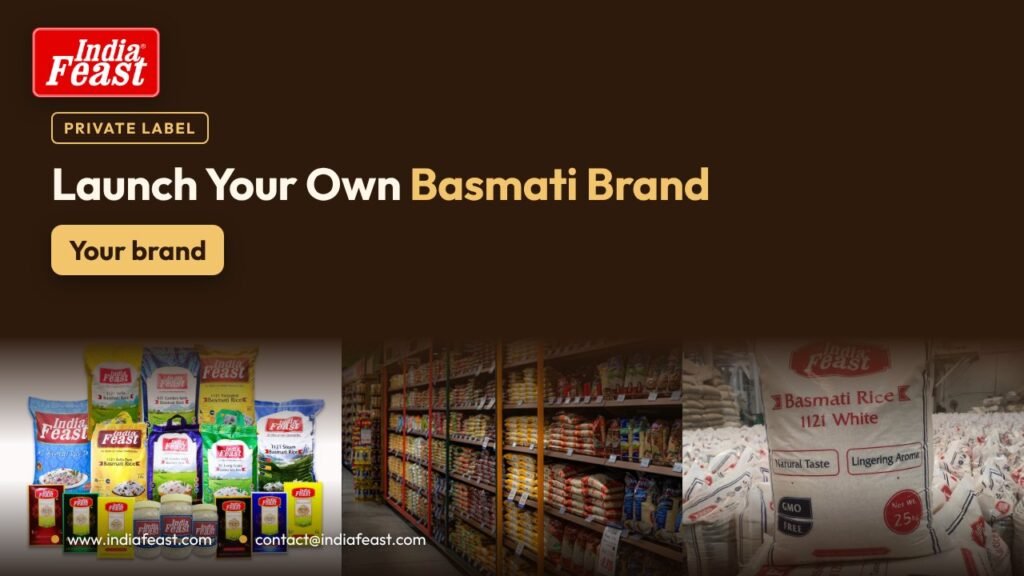
Private Label Basmati Rice from India: How Importers Launch Their Own Brand
By Indiafeast Team
Selling someone else's rice brand gives you a thin margin and no control. Sooner or later, many importers want their own name on the bag. Private label basmati rice lets you do that without owning a mill: an Indian basmati miller produces, grades and packs the rice, and you own the brand, the price and the customer.
Indiafeast Millers packs private label basmati rice for importers and brand owners. This private label basmati rice guide walks through the whole process the way it happens in real life, from picking the grade to the first container landing at your port.
Why importers move to private label basmati rice
- Margin. You set the shelf price for your own private label basmati rice brand rather than competing on someone else's.
- Loyalty. Shoppers and restaurants come back for your name. If you change mills later, the brand stays with you.
- Control. You choose the grade, age, pack and look. You can build a premium line and a value line under one brand family.
- Exclusivity. Your retailers get a product their competitors can't buy from the next distributor.
The trade-off is responsibility. With your name on the bag, your customers will judge you on every grain. That is why the mill you choose matters so much.
Step 1: Choose the grade and form
Start from your customer, not from the price list. Here is what we make and the usual fit:
| Grade | Avg grain length | Common private label rice use |
|---|---|---|
| 1121 | 8.30 to 8.40 mm | Premium retail, restaurants; available as golden, creamy, white and lemon sella, steam and raw |
| 1718 | 8.30 to 8.40 mm | Long-grain premium alternative |
| 1509 | 8.20 to 8.30 mm | Value premium line, catering packs |
| 1401 | 7.40 to 7.50 mm | Traditional-style basmati |
| Pusa | 7.10 to 7.30 mm | Everyday basmati, price-led ranges |
All grades: 12.5% max moisture, 1% max broken, 95% min purity (Indiafeast export specs). Brown basmati is also available in 1121, 1401, 1509 and 1718.
If you are torn between the two biggest grades, our comparison of 1121 and 1509 can help, and our basmati range page lists every form.
Step 2: Cook-test samples
Ask for samples of two or three options and cook them with your customers' recipes. We send free samples in 3 to 7 days; you cover courier and phyto charges. Keep part of the approved sample sealed. It becomes the quality reference for every future shipment of your brand.
Step 3: Pick the packaging
Packaging is half of a private label basmati rice brand. We work with 10 packaging types:
- Retail: LDPE pouch, vacuum pouch, mono carton and jar pack, typically in 1 kg retail sizes and from 500 g upwards.
- Wholesale and HoReCa: BOPP, PP laminated, PP woven, non-woven and jute bags in 10, 25 and 40 kg.
- Bulk: 1 MT jumbo bags (FIBC) for repackers.
Think about your channel. Supermarkets want shelf impact and a clean barcode area. Restaurants want a strong bag that survives the kitchen. Some Gulf wholesale buyers prefer jute or non-woven bags with a handle for the premium feel.
Step 4: Artwork and labelling
We provide artwork design support, but the legal content of the label depends on where you sell. As a guide:
- European Union: labels must follow Regulation (EU) No 1169/2011 on food information to consumers, which covers the product name, net quantity, best-before date, storage conditions, the business name and address, and nutrition information (EUR-Lex).
- United States: FDA labelling rules apply, including the statement of identity, net quantity, the name and place of business, and the Nutrition Facts panel (FDA food labeling).
- Gulf countries: Arabic labelling and local municipality or food authority rules apply. Your local registration agent will confirm the exact list.
Common label items for basmati: product name with grade (for example "1121 Golden Sella Basmati Rice"), net weight, country of origin India, crop year if you promote ageing, cooking instructions, importer details, batch number and best-before date. Ask your importer of record or a local regulatory consultant to check the final artwork. We will print exactly what you approve.
Step 5: Approve the proof
Before the full print run, approve a printed proof or a pre-production bag. Check colours, spelling, the barcode scan and the space left for batch and date coding. Changing a printed run later costs time and money.
Step 6: Order, payment and timeline
Once the proof is signed, the order goes into production. Our standard terms:
| Item | Indiafeast standard |
|---|---|
| Order to delivery | 45 to 60 days |
| Payment | 30% advance, 70% against shipping documents; LC and TT accepted |
| Incoterms | FOB, CNF, CIF, FOR, Ex-Works/Ex-Mill |
| Ports | Mundra, Kandla, Nhava Sheva, Chennai, Kolkata |
| Pack sizes | 500 g to 1 MT |
Minimum order quantity depends on the pack type and how the bags are printed, so we quote it with your artwork. A first order can mix two pack sizes in one container.
Step 7: Quality checks and shipping
Before loading, we check the lot against the approved sample and the agreed specs for grain length, moisture, broken and purity. The rice is Sortex cleaned and graded before packing. Shipping documents travel with every shipment. If you need a third-party inspection, agree it in the contract.
Common mistakes new private label basmati rice brands make
- Choosing on price alone. A cheap grade under a premium-looking bag disappoints shoppers and kills repeat sales.
- No written spec. "Same as sample" is not enough. Put numbers in the contract.
- Artwork last. Label approval often takes longer than milling. Start artwork while samples are being tested.
- Ignoring the season. Ramadan and festival demand push timelines. Plan launches with 45 to 60 days of lead time plus artwork time.
- Too many SKUs at launch. Start with one or two grades and sizes, learn, then expand.
Working out your landed cost
Before you fix a shelf price, add up every cost to your warehouse door, not just the rice price. A simple landed-cost sheet should include:
- Rice price per tonne for your grade and form (FOB or CIF).
- Packaging and printing cost per bag, which is higher for small retail packs.
- Sea freight and insurance if you buy FOB.
- Import duty, port charges and customs clearance in your country.
- Inland transport, storage and your distributor or retailer margin.
Current indicative rice levels are on our rice price page. For a firm figure, ask us for a quote with your packing details, because packaging can change the price per kilo more than buyers expect.
Labelling rules by market at a glance
Your bag is a legal document as well as a sales tool. Each market has its own food labelling law, and the importer of record is usually responsible for getting it right. Here is what most markets ask for, so you can plan the artwork before the first proof.
| Market | Main rule | Items buyers often forget |
|---|---|---|
| European Union | Food information rules under Regulation (EU) 1169/2011 | Name and address of the EU food business operator, minimum font size, language of the country of sale |
| United Kingdom | UK food information rules, similar to the EU structure | A UK address for the responsible food business, UK-specific nutrition format where used |
| USA | FDA food labelling rules (FDA food labeling) | Net weight in both metric and US units, Nutrition Facts panel where required, importer details |
| Gulf (GCC) | GCC and national standards for prepacked food | Arabic text, production and expiry dates, Halal marking where claimed |
This is a planning guide, not legal advice. Ask your importer of record or a local labelling consultant to check the final artwork for your market.
Two rules apply almost everywhere. First, the word "basmati" should only be used for genuine basmati varieties, so keep your supplier's variety and authenticity records. Second, any claim such as "aged", "extra long" or "pesticide free" must be something you can prove with documents for every lot.
Pack formats that sell in each channel
The right pack depends on where your rice will be sold. Choosing it early also fixes your MOQ, because printed bags have their own minimum runs.
- Supermarkets and hypermarkets: 1, 2 and 5 kg packs in printed BOPP or non-woven bags, often with a window or handle. Shelf appeal matters most here.
- Ethnic grocery stores: 5 and 10 kg bags are popular, sometimes with jute or premium non-woven finishes for festival seasons.
- Cash and carry and wholesale: 10, 20 and 25 kg bags in strong PP or BOPP, with clear grade and weight on the front.
- Restaurants and caterers: 25 and 40 kg bags where handling cost matters more than design.
- Online sales: smaller packs that ship well, with sturdy seals and a carton that protects the bag in transit.
Many new brands start with one or two pack sizes for one channel, then add sizes once the first SKUs sell well. That keeps printing costs and stock under control in year one.
How long does private label basmati rice take?
Timelines depend on artwork approval and printing, but a first order usually follows this pattern.
| Stage | Typical time |
|---|---|
| Samples and cook tests | 1 to 2 weeks (samples ready in 3 to 7 days, plus courier) |
| Artwork design and your label check | 1 to 3 weeks, depending on revisions |
| Bag printing | 2 to 4 weeks after final proof approval |
| Milling, sorting, packing and inspection | Planned together with printing |
| Order to delivery overall | About 45 to 60 days for most routes |
Repeat orders are faster, because the artwork and printing cylinders already exist. Plan your first order at least two months before the season you want to sell in, such as Ramadan or the year-end holidays.
Building the brand after launch
The first container is only the start. Private label basmati rice brands grow when the rice in the bag is the same every time. A few habits make a big difference:
- Lock the specs. Use the same grade, form, broken limit and ageing for every order, written in the contract.
- Keep a reference sample. Keep a sealed sample from your first approved lot and compare every new shipment to it.
- Plan reorders early. Track how fast each pack sells and reorder before stock runs low, so shelves never go empty.
- Listen to cooks. Ask shops and restaurants how the rice cooks. Small changes in water ratio advice on the pack can reduce complaints.
- Grow step by step. Add a second grade, for example a value 1509 next to a premium 1121, once the first line is steady.
If you are still choosing grades for your range, our 1121 vs 1509 basmati rice comparison explains which grade suits a premium line and which suits a value line.
How to choose a private label rice supplier
The supplier you pick decides whether your brand stays consistent for years or needs fixing after every shipment. Before you sign, ask each shortlisted private label rice supplier the same questions and compare the answers side by side.
- Registration and certificates: Ask for current APEDA registration, IEC, FSSAI and any Halal, HACCP or ISO certificates, and check the expiry dates yourself.
- Lab reports per lot: A good supplier shares moisture, grain length, broken percentage and, where your market needs it, pesticide residue reports for every lot, not just once.
- Sample matching: Ask how they make sure the shipped rice matches the approved sample. A sealed reference sample and pre-shipment inspection are the usual answers.
- Printing partners: Find out who prints the bags, the minimum print run and how long cylinders are kept for repeat orders.
- Communication: Notice how quickly and clearly they reply during the sample stage. That usually tells you how problems will be handled later.
- References: Ask for a buyer reference in your region, or start with a small trial order before committing to a large contract.
Price matters, but a slightly cheaper quote is rarely worth it if the grain changes from one container to the next. Shoppers notice when a rice they trust cooks differently, and a private label basmati rice brand only gets a few chances to win them back. For a full list of the specs to put in your contract, see our guide to basmati rice specifications for importers.
Many importers also visit, or send a local agent, before the first big order. Seeing how rice is stored, sorted and packed, and meeting the people who will handle your account, gives you a clear picture that no brochure can. If a visit is not possible, ask for a short video call during packing of your trial lot.
Private label rice manufacturers in India: what to compare
India has hundreds of rice exporters, but far fewer private label rice manufacturers that can mill, grade, pack and print to a brand owner's standard under one roof. When you shortlist private label rice manufacturers in India, compare them on the points that decide whether your brand will stay consistent, not only on price per tonne.
| What to compare | Why it matters for your brand |
|---|---|
| Own milling, Sortex sorting and grading | Control over grain length, broken % and colour from lot to lot |
| Range of grades and forms | Lets you add a value line (1509) next to a premium line (1121) later |
| Packaging types and minimum print runs | Decides your first-order size and how many SKUs you can launch |
| Certificates (APEDA, FSSAI, Halal, HACCP) | Needed by retailers and importers in most markets |
| Lab reports per lot | Proof for residue limits and quality claims on your pack |
| Artwork and label support | Saves weeks when you launch in a new country |
Ask every private label rice supplier on your list for the same sample set and the same quote format, then cook the samples side by side. The differences show quickly. A good private label basmati rice partner will also tell you honestly which grade suits your price point, even if it is not the most expensive one.
Honest limits
Private label basmati rice works best when you have your own sales channel: retailers, wholesalers or restaurants who already buy from you. If you are still building that network, look at becoming a distributor of an existing brand first. Our rice distribution programme explains that route.
How Indiafeast can help
Indiafeast Millers is APEDA-registered, with Halal, HACCP, GMP and FSSAI certifications. Alongside our own brands, Indiafeast Basmati Rice, SunGold Fresh Rice and Glory Rice, we pack rice under our buyers' labels with artwork support. Tell us your market, grade and pack, and we will send samples and a quote.
See private label options Start your brandMore from Indiafeast Millers
- See how every lot is cleaned, Sortex sorted and graded on our rice manufacturing process page.
- Compare all grades and forms in our basmati rice range, or look at the Indiafeast basmati rice packs.
- Check current FOB levels for 1121, 1509, 1718 and more on the basmati and non-basmati rice price page.
- Want rice under your own name? Read how private label rice packing works with us.
- New to us? Start at the Indiafeast Millers home page, read about the company, or ask for a quote.
FAQ: private label basmati rice
What is private label basmati rice?
Private label basmati rice is basmati milled and packed by a manufacturer but sold under the buyer's own brand name. The buyer owns the brand and the customer relationship; the mill handles production and packing.
What is the MOQ for private label basmati rice?
It depends on the pack type, bag size and printing method. We quote MOQ together with your artwork and packing choice. A first order can be one mixed container.
How long does private label rice take from India?
At Indiafeast, 45 to 60 days from order to delivery. Allow extra time before that for sample testing and artwork approval.
Do you help with packaging design?
Yes. We offer artwork design support, and we print exactly the label content you approve. The legal wording for your market should be checked by your importer of record.
Which packaging is best for supermarket basmati?
Retail buyers often use 1 kg LDPE or vacuum pouches, mono cartons or jar packs. For family packs, printed BOPP or non-woven bags work well.
How long does it take to launch private label basmati rice?
A first private label basmati rice order usually takes about 45 to 60 days from order to delivery, plus 2 to 5 weeks before that for samples, artwork and proof approval. Repeat orders are faster because the artwork and printing set-up already exist.
Which labelling rules apply to private label basmati rice?
The rules of the country where the rice is sold apply, such as EU Regulation 1169/2011, UK food information rules, FDA labelling in the USA or GCC standards in the Gulf. The importer of record is usually responsible, so have the final artwork checked for your market.
How do I find private label rice manufacturers in India?
Start with APEDA-registered exporters that have their own milling and packing, check their certificates and ask for samples and a private label quote. Shortlist two or three private label rice manufacturers, cook-test the samples, compare packaging options and minimum print runs, and start with a trial order before a long contract.
Is white label basmati rice the same as private label?
They are often used to mean the same thing. White label basmati rice usually means a ready product that several brands sell with their own sticker or bag, while private label basmati rice is packed to one brand owner's chosen grade, pack and artwork. Most importers launching their own brand want true private label.
Written by Indiafeast Team, Indiafeast Millers. Labelling notes are a general guide only and not legal advice. Always confirm current requirements with your local authority.