

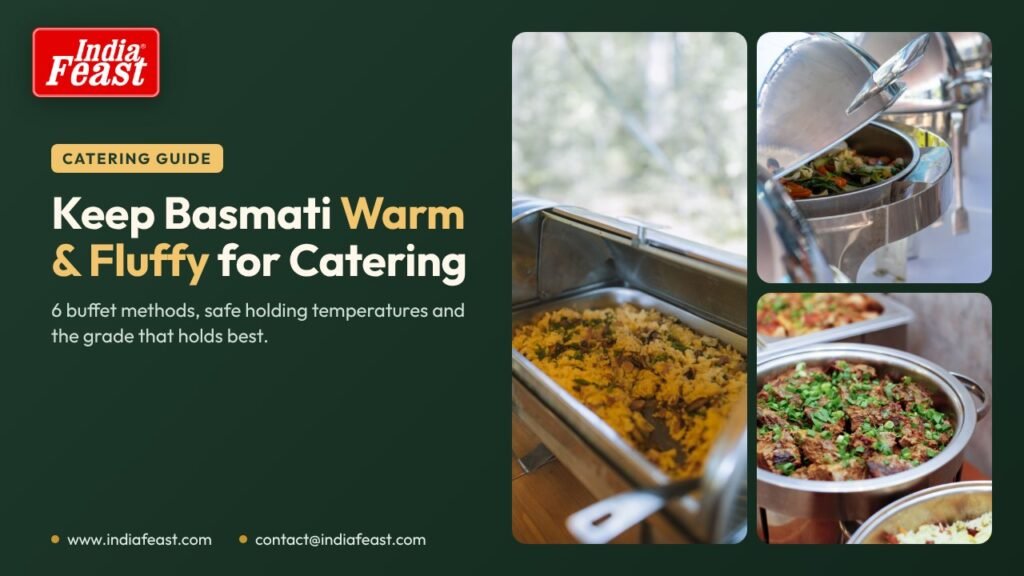
How to Keep Basmati Rice Warm and Fluffy for Catering: 6 Buffet Methods
By Indiafeast Team · Updated 23 November 2026
Cooking good rice for a wedding or a hotel buffet is only half the job. The harder part is keeping it hot, fluffy and safe for two or three hours while guests come back for more. Rice that sits uncovered dries out and turns hard at the edges. Rice that is covered too tightly in a deep pan steams itself into a soft, sticky block.
This guide shows you how to keep basmati rice warm for catering without losing the long, separate grains your guests expect. It covers six holding methods, the safe temperatures food agencies give, which basmati grade holds best, and a simple service plan for 50 to 500 guests. The Indiafeast Team supplies basmati to caterers and hotels, and these are the methods their kitchens rely on.
Why basmati dries out or turns mushy on a buffet
Before you choose a method, it helps to know why buffet rice fails. If you understand the two ways it goes wrong, it becomes much easier to keep basmati rice warm and still serve it looking freshly cooked.
Cooked rice keeps changing after it leaves the pot. Two things happen at the same time on a buffet line:
- Moisture escapes. Open trays lose steam into the room, so the top layer and the edges dry and harden first.
- Starch settles. In a deep, tightly covered pan, the steam has nowhere to go. It condenses, drips back and softens the grains at the bottom, which then stick together under the weight of the rice above.
Good holding is about balance: enough cover to keep moisture in, a shallow layer so the rice does not crush itself, and steady heat so it stays safe. The grade of rice also matters a great deal, as you will see below.
Safe holding temperature for cooked rice
Hot holding is not only about texture. It is the step that keeps buffet rice safe, so every chafing dish, bain-marie or cabinet on your line needs a thermometer check.
Cooked rice needs extra care because of Bacillus cereus, a bacterium whose spores can survive cooking. If cooked rice is left warm but not hot, the spores can grow and make toxins that reheating may not destroy. The Food Standards Scotland rice guidance explains why rice should be eaten hot or cooled quickly and chilled.
| Guidance | Hot holding | What it means for your buffet |
|---|---|---|
| UK food safety guidance | 63°C or above | Check the rice in the pan, not just the burner setting |
| USDA (USA) | 140°F (about 60°C) or above | Hot foods should be kept hot, with leftovers chilled promptly (USDA FSIS) |
| Leftovers | Cool fast, chill | Spread on trays and refrigerate within an hour of coming off the line |
Rules differ by country and local authority. Follow your own food safety plan and local regulations, and use a probe thermometer to check the rice regularly.
Which basmati grade holds best
The grade decides how long you can keep basmati rice warm before it loses its shape. When you buy basmati rice for catering, ask for a grade that is made for long hot holding, not only for a plated dinner.
Not every basmati behaves the same on a hot line. Parboiled sella rice is the caterer's favourite for a reason: the grain is harder and denser, so it can sit in steam for longer without splitting or turning sticky. You can read more about how parboiling changes the grain in our parboiled rice explainer.
| Grade | Holding performance | Best use |
|---|---|---|
| 1121 Golden Sella | Excellent. Stays long and separate for the longest time | Weddings, banquets, Gulf and African menus |
| 1121 White Sella | Excellent. Same firmness with a whiter look | Hotels, fried rice stations, plain rice |
| 1121 Steam | Good. Softer than sella but holds well for shorter service | Biryani, à la carte, smaller events |
| 1121 Raw | Fair. Most aroma, but softens and breaks sooner | Plated service, short buffets |
If you are deciding between forms for a new menu, our guide to the difference between raw, steam and sella basmati explains how each one cooks.
6 ways to keep basmati rice warm for a buffet
1. Chafing dish with a water bath
The classic buffet option. Fill the lower pan with hot water, light the fuel or switch on the electric element, and put the rice in the top pan. The water spreads the heat evenly, so the bottom does not scorch. Keep the lid closed between servings and top up the water during long events.
2. Bain-marie or hot well
In hotel kitchens and on fixed buffet counters, a bain-marie is the most reliable choice. Use gastronorm pans no deeper than 65 mm for rice, cover with a lid or foil, and keep the well at a setting that holds the rice above 63°C.
3. Heated holding cabinet
Holding cabinets keep full pans hot behind the line. Choose a humidified cabinet if you have one, because dry heat pulls moisture out of rice. Rotate pans to the front so the oldest rice goes out first.
4. Low oven
If you have no holding equipment, a conventional oven works. Cover the pans tightly with foil and keep them in a low oven, checking with a probe that the rice stays above 63°C. Place a tray of hot water on the bottom shelf to add moisture.
5. Insulated food carriers
For off-site catering, insulated carriers keep full pans hot during transport and for a while after arrival. Pre-heat the carrier with hot water, fill it with rice straight from the steamer and keep it closed until service. Check the temperature before serving.
6. Rice cooker or slow cooker on warm
For small events, a large commercial rice cooker on its keep-warm setting is simple and safe. Fluff the rice once after cooking, then leave the lid closed. A slow cooker on warm also works for smaller quantities if it holds the rice above 63°C.
Buffet basmati for 50 guests
This is the base recipe most caterers use for buffet rice. Cook it in batches, keep each chafing dish covered, and you will keep basmati rice warm, fluffy and separate for the whole service.
This is a simple base recipe for 50 guests, cooked by the boil-and-drain method that most caterers prefer. It gives very separate grains that hold well on a buffet.
Ingredients (serves 50)
- 5 kg 1121 golden sella basmati rice
- 40 litres water for boiling (cook in 2 or 3 pots)
- 150 g salt, or to taste
- 200 g ghee or butter, divided
- 10 green cardamom pods, 4 bay leaves and 10 cloves (optional)
- Juice of 1 lemon (optional, keeps the grains white and separate)
How to cook and hold rice for a buffet
- Wash and soak. Wash the rice in smaller lots until the water runs nearly clear, then soak it for 45 to 60 minutes. Drain well.
- Boil in plenty of water. Bring the water to a rolling boil in 2 or 3 large pots with the salt, whole spices and lemon juice. Add the rice and boil uncovered for 10 to 12 minutes, until about 90% cooked.
- Drain and spread. Drain in large colanders, then divide the rice between hotel pans so it is no more than 5 to 8 cm deep.
- Steam to finish. Dot each pan with ghee, cover tightly with foil and steam or oven-cook for 15 to 20 minutes until fully tender.
- Fluff once. Uncover, fluff gently with a fork from the edges, then cover again straight away to keep the steam in.
- Move to holding. Put the pans into the chafing dish, bain-marie or holding cabinet and check that the rice is above 63°C.
- Refresh during service. Every 30 to 45 minutes, fluff the top layer and, if it looks dry, sprinkle a little hot water and a few drops of ghee, then re-cover.
- Replace, do not top up. Swap in a fresh pan rather than piling new rice on top of old rice. Chill any leftovers quickly on trays.
Plan about 100 g of dry rice per guest for a buffet with several other mains, and 120 to 150 g where rice is the main dish. Adjust for your menu.
Tips to stop rice drying out
- Cover with a damp cloth under the lid. A clean, damp tea towel between the rice and the lid keeps moisture in without dripping water back onto the grains.
- Use ghee or butter. A light coat of fat on the grains slows moisture loss and keeps the rice glossy.
- Keep layers shallow. Deep pans crush the bottom layer and dry the top. Two shallow pans hold better than one deep pan.
- Cook slightly firm. Rice keeps cooking in the holding pan. Stop at just-tender so it is perfect, not soft, an hour later.
- Cook in waves. For long events, start a second batch 45 to 60 minutes after the first so fresh rice is always ready.
- Serve from the edges. Ask servers to lift rice gently from the side of the pan rather than digging into the middle and pressing it down.
Planning rice for large events
Good planning is the easiest way to keep basmati rice warm without overcooking it: cook only what the next 60 to 90 minutes of service need, and keep the rest of your basmati rice for catering soaked and ready.
| Guests | Dry rice (main dish) | Hotel pans (65 mm) | Batches |
|---|---|---|---|
| 50 | 5 to 7.5 kg | 4 to 6 | 1 to 2 |
| 100 | 10 to 15 kg | 8 to 12 | 2 to 3 |
| 250 | 25 to 37.5 kg | 20 to 30 | 3 to 4 |
| 500 | 50 to 75 kg | 40 to 60 | 4 to 6 |
These are planning figures. The real amount depends on how many other mains you serve and how hungry your guests are. Keep a written log of what you cooked and what came back, and adjust for the next event.
How long can basmati be held hot? Texture times by method
Food safety rules tell you the minimum temperature. They do not tell you how long the rice will still look and taste good. That depends on the method, the depth of the pan and the grade. The figures below are practical texture windows that catering kitchens work to with soaked, well-drained 1121 golden sella basmati. Treat them as a starting point and check your own line, because burners, lids and room temperature vary.
| Holding method | Best texture window | Main risk | Fix |
|---|---|---|---|
| Chafing dish with water bath | 60 to 90 minutes per pan | Edges dry under the lid gap | Damp cloth under the lid, swap pans often |
| Bain-marie or hot well | 90 to 120 minutes | Bottom layer softens | Shallow 65 mm pans, never deep pots |
| Heated holding cabinet | 2 to 3 hours | Drying if humidity is off | Use the humidity setting or cover with foil |
| Low oven (about 70 to 80°C) | 60 to 90 minutes | Crust on top and sides | Foil cover, a spoon of ghee, a splash of hot water |
| Insulated carrier | 2 to 4 hours, if packed piping hot | Temperature slowly falls | Pre-heat the carrier, probe on arrival |
| Rice cooker on warm | 45 to 60 minutes | Grains go soft and sticky | Move to a pan for long service |
Two patterns stand out. First, the shallower the rice, the longer it holds its shape, because less weight presses down on the bottom grains. Second, parboiled sella holds two to three times longer than raw basmati in the same pan, which is why most hotel and wedding caterers in the Gulf and South Asia cook sella for any service longer than an hour.
Cook-chill and reheat: when hot holding is not possible
Sometimes you cannot cook on site, or the event runs late into the night. In that case the safe alternative to holding rice hot for hours is to cook, chill fast and reheat once. Cooked rice can carry spores of Bacillus cereus, a bacterium that survives cooking and can multiply if rice sits warm. The UK Food Standards Agency advises cooling cooked rice quickly, ideally within an hour, keeping it in the fridge for no more than a day, and reheating it only once until it is steaming hot all the way through. US food safety guidance follows the same idea: cool cooked food quickly through the danger zone and reheat leftovers to 165°F (74°C).
- Cook slightly firm. Take sella basmati off the heat a minute early so it does not overcook when reheated.
- Spread thin to cool. Tip the rice onto clean trays no more than 5 cm deep. Never leave it to cool in the pot.
- Chill and label. Cover, label with the cooking time and move to the fridge as soon as the steam stops.
- Reheat in small batches. Use a combi oven with steam, a covered tray with a little water, or a steamer, until the centre is steaming hot.
- Serve, then do not reheat again. Any rice that comes back from the buffet after reheating is thrown away.
Sella basmati is the best grade for this cook-chill route because the parboiled grain does not break or turn mushy when it is warmed a second time. Steam and raw basmati can be reheated too, but they lose more texture.
Holding rice at outdoor events and in hot climates
Outdoor weddings, desert camps and Ramadan iftar tents bring their own problems. Wind blows heat away from chafing dishes, fuel cans burn out faster, and in Gulf summers the air can be hotter than the rice on a cold tray. A few habits help:
- Shield the line. Place chafing dishes away from fans and open sides, or use wind guards. Wind can drop the rice temperature in minutes.
- Carry spare fuel. Plan at least one extra fuel can per chafing dish per two hours of service.
- Hold in the van, not on the table. Keep back-up pans in an insulated carrier or a holding cabinet and bring out one pan at a time.
- Probe every 30 minutes. Write the reading on a simple log sheet. It protects your guests and your business if an inspector asks.
- Keep it covered in dust and sand. Lids stay on between guests, and servers lift them only to plate.
A 7-point buffet rice checklist for your team
- 1. Right grade: 1121 golden sella or white sella for any service over 60 minutes
- 2. Soak and drain: 45 to 60 minutes soak, drain well before cooking
- 3. Cook in batches: the next pan should finish as the current one runs low
- 4. Shallow pans: 5 to 8 cm deep, never one big pot
- 5. Always covered: lid, foil or a damp cloth
- 6. Probe and log: 63°C or above, checked every 30 minutes
- 7. No topping up: swap the whole pan, never mix old and new rice
Common mistakes caterers make
Most buffet rice problems come from a handful of habits. Each one is easy to fix once your team knows to look for it.
- Holding one giant pot for the whole event. The bottom turns mushy and the top dries out. Use several shallow pans.
- Leaving the lid off. Uncovered rice loses its fluffiness within minutes under buffet lights.
- Mixing old and new rice. Topping up a half-empty pan mixes textures and makes food safety tracking harder.
- Guessing the temperature. Burners and fuel cans vary. A probe thermometer is the only way to know the rice is above 63°C.
- Using a soft grade for long service. Raw basmati is lovely for plated dishes but struggles in a two-hour buffet. Choose sella.
More from Indiafeast Millers
- Cooking for the buffet? Use our golden sella cooking method and the best rice for mandi guide.
- See how every lot is cleaned, Sortex sorted and graded on our rice manufacturing process page.
- Compare all grades in the basmati rice range or look at the Indiafeast basmati rice packs.
- Check current export levels on the basmati and non-basmati rice price page.
- Want rice under your own name? Read how private label rice packing works.
- New to us? Start at the Indiafeast Millers home page.
Buying basmati rice for catering?
Indiafeast Millers supplies 1121 golden sella and white sella basmati in 25 and 40 kg catering bags, plus private label packs for food service distributors. Ask for a sample and test it on your own buffet line.
Request a catering rice sampleFAQ
How do you keep basmati rice warm for a party?
Keep it covered in a chafing dish, bain-marie, holding cabinet or low oven at 63°C or above. Spread it in shallow pans, add a little ghee and sprinkle with hot water if it starts to dry.
What temperature should cooked rice be held at?
UK guidance is 63°C or above for hot holding. In the USA, USDA guidance is 140°F, about 60°C, or above. Check the rice itself with a probe thermometer.
How long can rice stay in a chafing dish?
For the best texture, replace pans every 60 to 90 minutes. Safety limits depend on your local rules and food safety plan, so follow those and keep the rice hot throughout.
Which basmati rice is best for buffets?
1121 golden sella or white sella basmati holds best, because the parboiled grain stays firm and separate in steam for longer than raw or steam basmati.
How do I stop buffet rice from drying out?
Keep it covered, use shallow pans, coat the grains lightly with ghee or butter, and refresh the top with a light sprinkle of hot water every 30 to 45 minutes.
Can I cook rice the day before a catering event?
You can, if you cool it quickly on trays, chill it within an hour and reheat it until steaming hot. Many caterers prefer to cook on the day in batches for the best texture.
Can you keep basmati rice warm overnight?
No. Holding rice warm overnight is not safe, because it can spend hours in the temperature range where bacteria grow. Cool it quickly, refrigerate it and reheat it once until steaming hot the next day, or cook fresh rice.
How do you keep rice warm at an outdoor event?
Use covered chafing dishes shielded from wind, carry spare fuel, keep back-up pans in an insulated carrier, and probe the rice every 30 minutes to make sure it stays at 63°C or above.
Written by Indiafeast Team, Indiafeast Millers. Methods and sources checked on 13 November 2026. Always follow your local food safety rules and your own food safety plan.